About
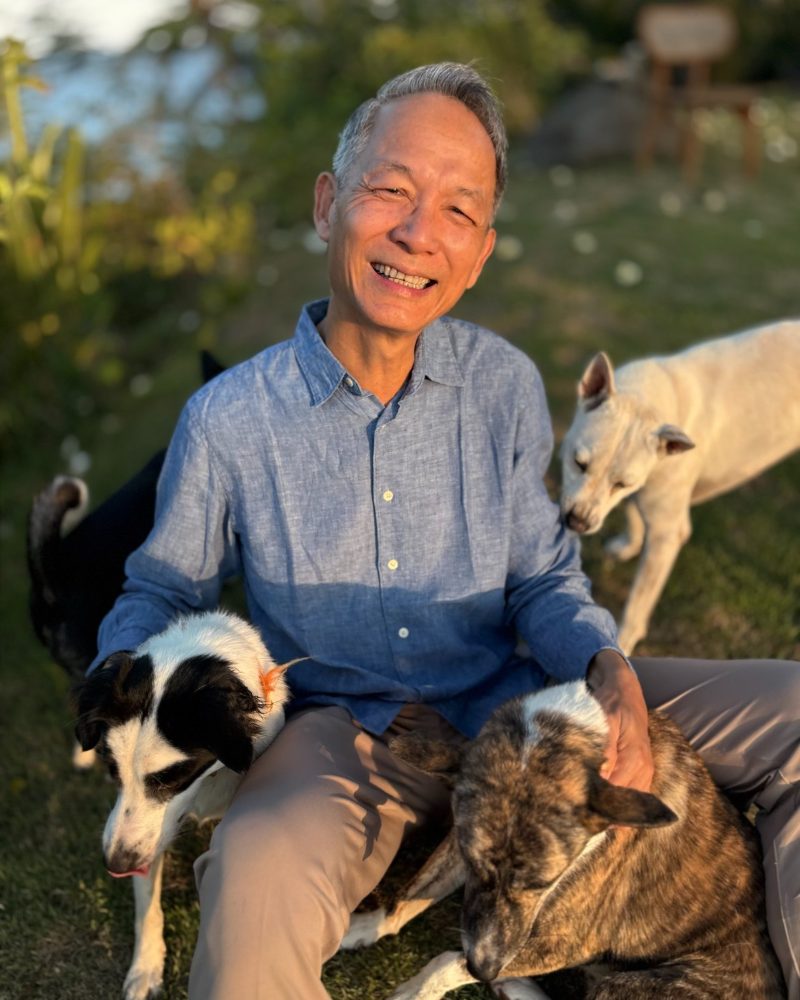
I was born in Singapore, raised by a single mother in a two-bedroom HDB flat, and I live now in Bali, on the east coast, at the foot of the volcano. Between those two facts are thirty-eight years in the United States.
I left at seventeen, on a scholarship to a United World College in the New Mexico desert — the first of a series of departures that took a Chinese Singaporean boy a very long way from home. Princeton followed, then Harvard Divinity School, then, some years later, Harvard Business School. It was an attempt to answer a question from as many directions as possible.
I was ordained a priest in the Episcopal Church in 1996, and I remain one. I have not held a parish in many years and my work now is secular. But I have never experienced it as two kinds of work. What I learned as a young priest — how to sit with someone at the hour when what they have built and what they are come under the same strain, and not leave — is the same thing I do now, in rooms that look nothing like a church, with people of every faith and none. I do not bring religion into that room. I bring the attention.
I have coached since 2002. Most of it has been with senior people and the organizations they run — in Asia, Europe, and North America — first as a coach on leadership-development teams inside large financial and Fortune 500 firms, later on my own, and for the last several years with the families behind family enterprises. For nearly twenty years I have been part of INSEAD, coaching in its executive programmes and supervising candidates in the Executive Master in Change, its programme for reading what is actually happening beneath the surface of people and organizations. Supervising others who do this work is the part I value most.
The training behind it is more experiential than academic. Group relations and T-groups; the staffing of group relations conferences; Barry Oshry's power laboratory; Bill Torbert's action inquiry and Ron Heifetz's adaptive leadership; clinical pastoral training in a Los Angeles hospital. I trained formally as a coach and hold a qualification in organization development from Teachers College, Columbia University.
I have also built things. From 2006 to 2009 I designed and led a responsible-leadership programme for a global professional-services firm, which took senior professionals out of their roles for three weeks and placed them with grassroots organizations in Bhutan, Yunnan, and Cambodia. That programme is the direct ancestor of WE-Empower, which I founded in Singapore and which pairs experienced professionals with small-enterprise leaders across Southeast Asia. Earlier I co-founded SEALNet, which develops service leadership among young people in the region.
Before all of it I went to the mountains. Alaska, mostly, over twenty years: the Wrangell–St. Elias, the peaks above the Chugach, an expedition to summits nobody had climbed, and later a long kayak into Prince William Sound. What they taught me was practical — how a party comes apart on the ninth cold day, how to read weather, where the ground gives way — and it is the closest thing I have to an origin for the work I do now. We meant to summit. We tried hard to summit. Sometimes we did not, and that is in the nature of it. The expedition was good because of the doing of it. That is true of a business and of a family and of a life.
The three things this site is arranged around — work, people, self — are not my invention. Older traditions have counted the treasures of a life in threes, and the phrase 三寶 will be familiar to Chinese and Vietnamese readers, as will its equivalents elsewhere. I have borrowed the shape. There is the work we give ourselves to, there are the people we are bound to, and there is the self we have to live inside and answer for. They do not stay apart, and a person who is failing in one is usually paying for it in the others.